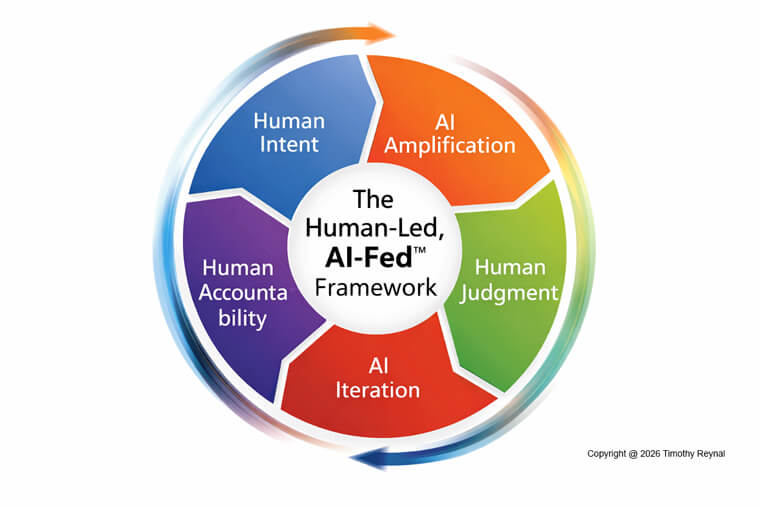
A Governance Framework for Responsible Artificial Intelligence Integration
Developed by Timothy Reynal
Introduction
Artificial intelligence is rapidly transforming how organizations analyze information, create solutions, and execute complex work. Yet many organizations face a central dilemma: how to harness the power of artificial intelligence without losing the judgment, ethics, and accountability that human expertise provides.
The Human-Led, AI-Fed™ Model for AI-Augmented Work offers a structured framework that balances these two forces.
Rather than viewing artificial intelligence as a replacement for human intelligence, the model positions AI as an amplifier of human capability. Humans remain responsible for defining direction, evaluating outcomes, and maintaining accountability, while artificial intelligence accelerates discovery, iteration, and scale.
This framework establishes a governance structure for organizations seeking to integrate artificial intelligence responsibly while preserving human leadership.
Core Principle
At the center of the Human-Led, AI-Fed™ Model lies a simple principle:
Humans define intent and accountability.
Artificial intelligence accelerates analysis, exploration, and execution.
This principle ensures that artificial intelligence enhances human capability rather than displacing human responsibility.
The Five Pillars of the Human-Led, AI-Fed™ Model
The model is built upon five interconnected pillars that guide the collaboration between human expertise and artificial intelligence.
1. Human Intent
Every meaningful initiative begins with human direction. Humans define the purpose, scope, and ethical boundaries of work.
Human intent establishes:
- the problem to be solved
- strategic objectives
- ethical and regulatory boundaries
- desired outcomes
Artificial intelligence should never determine mission or purpose. These responsibilities belong to human leadership.
2. AI Amplification
Artificial intelligence serves as a powerful amplification engine for human inquiry and creativity.
AI amplification enables organizations to:
- analyze large datasets rapidly
- generate alternative approaches to complex problems
- produce initial drafts of designs, code, or content
- identify patterns not immediately visible to human observers
Through amplification, AI extends the reach of human intelligence without replacing it.
3. Human Judgment
Human expertise provides contextual understanding that artificial intelligence cannot replicate.
Human judgment ensures that outputs generated by AI are evaluated through the lens of:
- domain expertise
- real-world constraints
- ethical considerations
- cultural awareness
- long-term consequences
This pillar reinforces the principle that AI may generate possibilities, but humans determine which possibilities are valid and appropriate.
4. AI Iteration
Artificial intelligence excels at rapid iteration.
Once human judgment establishes direction, AI can accelerate refinement through:
- simulation
- rapid prototyping
- optimization cycles
- scenario modeling
- workflow automation
5. Human Accountability
Responsibility for decisions and outcomes must remain human-centered.
Human accountability includes:
- regulatory compliance
- safety oversight
- ethical responsibility
- organizational decision-making
- societal impact
Artificial intelligence can assist with analysis and recommendations, but final accountability must always remain with human leadership.
The Operational Cycle
When these pillars operate together, organizations create a continuous cycle of progress:
Human intent defines the mission.
AI amplification expands exploration.
Human judgment evaluates outcomes.
AI iteration refines solutions.
Human accountability governs final decisions.
This cycle allows organizations to move forward with both speed and responsibility.
Benefits of the Human-Led, AI-Fed™ Model
Organizations that adopt this framework gain several advantages:
Enhanced Productivity
AI tools significantly reduce the time required for research, drafting, and analysis.
Improved Decision Quality
Human expertise ensures that AI-generated outputs are evaluated within real-world context.
Ethical Safeguards
Human accountability protects organizations from unintended consequences associated with uncontrolled automation.
Scalable Innovation
AI iteration allows organizations to test and refine ideas more rapidly than traditional development cycles.
Applications Across Industries
The Human-Led, AI-Fed™ Model is applicable across many sectors, including:
Engineering and product development
Healthcare and medical research
Software development
Financial services
Public policy and governance
Creative industries
Education and training
Any field that combines human expertise with complex information systems can benefit from structured AI augmentation.
Governance Considerations
Organizations implementing this model should establish clear governance policies, including:
- defined human review points in AI workflows
- transparency regarding AI-generated content or analysis
- regulatory compliance procedures
- continuous monitoring of AI performance and limitations
These governance measures ensure that artificial intelligence remains a responsible partner in decision-making processes.
Conclusion
Artificial intelligence will continue to reshape the landscape of knowledge work and innovation. The question facing organizations is not whether AI will play a role in the future of work, but how that role will be defined.
The Human-Led, AI-Fed™ Model provides a balanced approach in which human expertise remains central while artificial intelligence enhances the scale, speed, and creative potential of modern work.
By preserving human leadership while embracing AI augmentation, organizations can achieve both innovation and responsibility in the next generation of technological progress.
© 2026 Timothy Reynal. All rights reserved.
Published by Bytes, Inc. under non-exclusive license.
Unauthorized reuse, modification, or redistribution prohibited without written permission.