
TL;DR -- 20-Second Read
MedTech and Biopharma startups get stuck choosing vendors because of regulatory fear, cost concerns, and too many options.
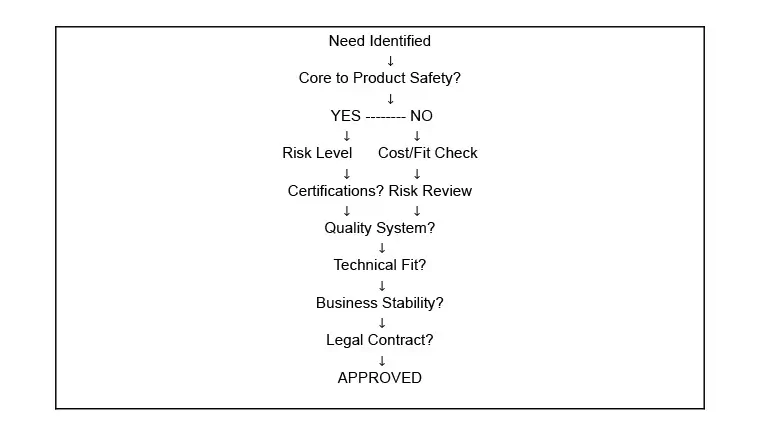
Use this simple framework:
- Decide if vendor affects product safety
- Classify vendor risk level
- Verify certifications and quality system
- Confirm technical fit and financial stability
- Use a scoring matrix to end debates
- Document everything for FDA and investors
Indecision costs more than a structured imperfect choice.
Move forward with evidence, not endless debate.
How MedTech and BioPharma Startups Can Break Vendor Selection Paralysis
A practical framework to move forward with confidence
Every MedTech and BioPharma startup eventually hits the same wall.
You need a contract research organization
A manufacturing partner
A sterilization provider
A clinical data platform
A verification and validation lab
And suddenly your team freezes.
Too many options
Too many risks
Too many opinions
Weeks turn into months while the runway disappears.
At Bytes Biomedical Division, we see this constantly. Smart founders become stuck not because they lack intelligence, but because vendor decisions in regulated industries feel permanent and dangerous.
The good news: vendor selection can be structured, defensible, and fast.
Why MedTech and BioPharma Teams Get Stuck
Vendor paralysis usually comes from three real fears:
- Regulatory fear
Choosing the wrong vendor could derail FDA clearance or approval - Financial fear
A bad contract could burn scarce capital - Reputation fear
Investors or auditors may question your judgment later
These fears are rational. Vendor choices become part of your design history file, device master record, trial master file, and inspection trail.
But the answer is not endless debate.
The answer is a clear decision framework.
Step 1: Ask One Critical Question First
Is this vendor connected to product safety or regulatory compliance
If yes, treat them as a regulated vendor
If no, use a simpler evaluation path
Examples of regulated vendors for MedTech and BioPharma
MedTech
Verification and validation labs
Biocompatibility testing labs
Sterilization providers
Component manufacturers
Software validation vendors
BioPharma
Contract research organizations
API manufacturers
Fill-finish partners
Clinical data platforms
Stability testing labs
Examples of standard vendors
Marketing agencies
Recruiting firms
Office IT services
Different paths. Different rigor.
Step 2: Classify Vendor Risk
Not all regulated vendors are equal.
Classify them into three levels.
Critical
Direct impact on patient safety, clinical data, or product performance
Examples: CRO running trials, sterile manufacturing site, implant material supplier
Major
Indirect impact on product quality
Examples: packaging vendor, data hosting platform, labeling supplier
Minor
Low impact
Examples: janitorial services, office logistics
Scaling your effort keeps momentum without ignoring risk.
Step 3: Verify Regulatory Readiness
Before discussing price, check the fundamentals.
Does the vendor have relevant certifications or inspection history
For MedTech
ISO 13485
FDA registration
Device manufacturing experience
For BioPharma
Good Manufacturing Practice GMP
Good Clinical Practice GCP
Good Laboratory Practice GLP
FDA inspection history
If they cannot demonstrate compliance, stop early.
Startups often skip this step and pay later during audits or due diligence.
Step 4: Review Their Quality System
A serious vendor should provide
Quality manual
Standard operating procedure list
Corrective and preventive action history
Change control process
Audit reports
Remember, your vendor’s quality system becomes part of your regulatory story.
For device startups, this ties into design controls and risk management.
For drug startups, it ties into batch traceability and clinical integrity.
Step 5: Confirm Technical Fit
A serious vendor should provide
Quality manual
Standard operating procedure list
Corrective and preventive action history
Change control process
Audit reports
Remember, your vendor’s quality system becomes part of your regulatory story.
For device startups, this ties into design controls and risk management.
For drug startups, it ties into batch traceability and clinical integrity.
Step 6: Evaluate Business Stability
A technically perfect vendor who fails financially still creates risk.
Review:
- Financial stability
- Years in operation
- Client references
- Insurance coverage
- Supply chain reliability
Startups sometimes choose vendors as fragile as they are. That risk multiplies quickly.
Step 7: Lock Down the Contract
A regulated vendor agreement should include:
- Quality agreement
- Confidentiality and intellectual property protection
- Audit rights
- Service level agreements
- Liability coverage
Without a quality agreement, hidden risk remains.
This is true whether you are building a wearable device or a cell therapy platform.
Step 8: Use a Scoring Matrix to End Debates
When teams cannot decide, numbers help.
Score vendors on:
- Regulatory compliance
- Technical capability
- Cost
- Timeline
- Financial stability
- Cultural fit
Document the results.
Auditors respect documented logic. Investors do too.
This turns opinion into evidence.
Step 9: Document Everything
Save and store:
- Vendor questionnaires
- Risk assessments
- Meeting notes
- Audit reports
- Decision rationale
When the FDA or a potential acquirer asks why you chose a vendor, you will have a clear answer.
This reduces anxiety across your leadership team.
The Hidden Cost of Indecision
Vendor paralysis delays:
- Clinical milestones
- Verification and validation
- Investor confidence
- Market entry
- Patient impact
Perfection is rarely available in startups.
But structured decisions are.
When to Ask for Help
If your MedTech or BioPharma team is stuck debating vendors for more than two weeks, bring in experienced regulatory partners.
An external team can:
- Run vendor qualification audits
- Build scoring models
- Review contracts
- Identify hidden risks
- Accelerate decisions
This is where Bytes Biomedical Division often steps in.
We do not sell you vendors.
We give you confidence that your decision will survive FDA review, investor diligence, and real-world scaling.
A Final Thought
Every MedTech device and every BioPharma therapy begins with hope.
Hope for a safer implant
Hope for a new treatment
Hope for a longer life
Vendor decisions are not paperwork. They are part of that mission.
Choose with structure, not fear.
Move forward with evidence, not endless debate.
Patients are waiting.
Summary
- Pick vendors who understand design controls and validation
- Always sign a Quality Agreement
- Document every decision
- Avoid startups as critical vendors unless audited
- Investors and FDA both care about vendor controls
© 2026 Timothy Reynal. All rights reserved.
Published by Bytes, Inc. under non-exclusive license.
Unauthorized reuse, modification, or redistribution prohibited without written permission.